
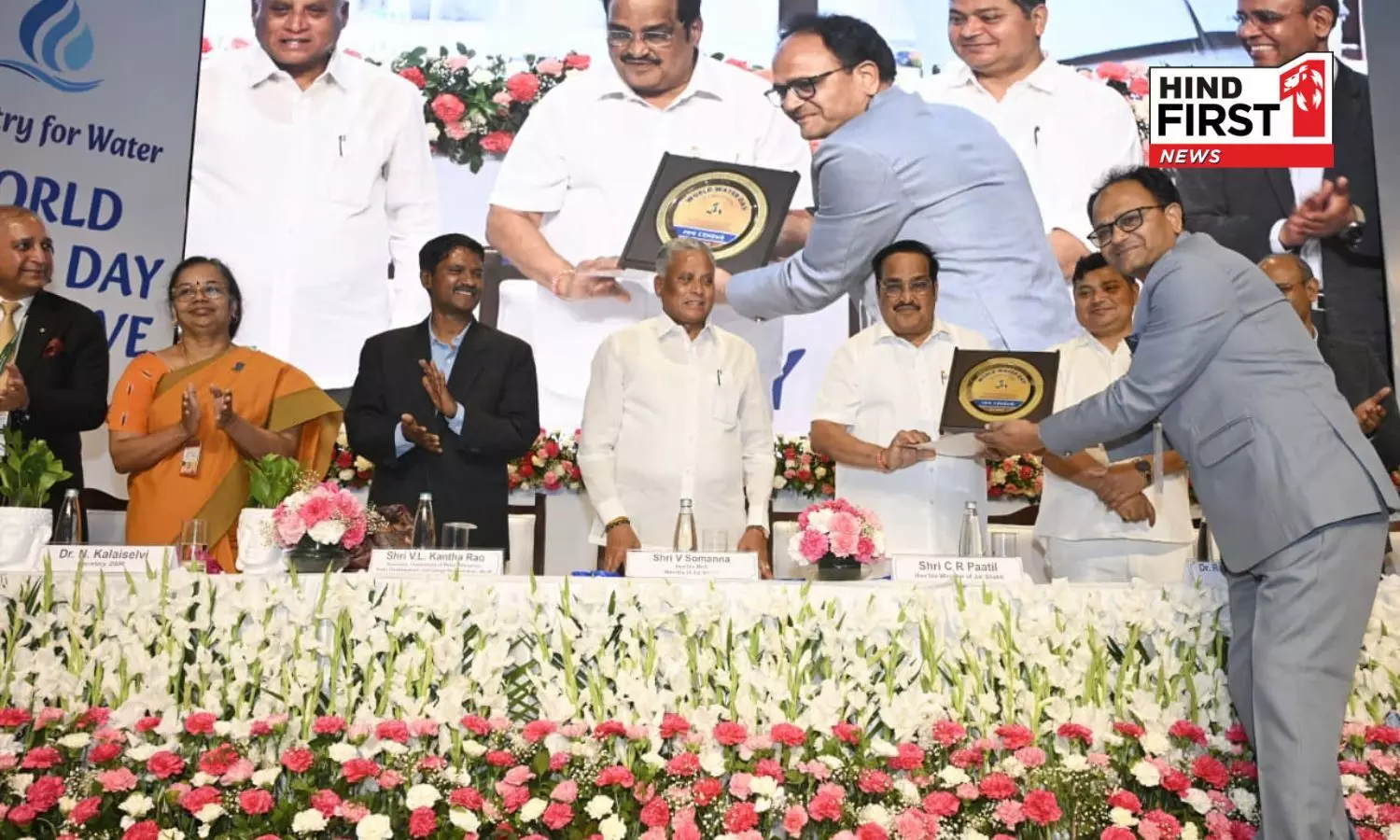
World Water Day Conclave Organized Under the Chairmanship of Union Minister of Jal Shakti, C.R. Patil
Addressing the gathering, Union Minister of Jal Shakti C.R. Patil remarked that this day serves as a reminder of the critical importance of water and the necessity of its conservation.

"Inspired by the call of Hon'ble Prime Minister Shri Narendra Modi—to transform water conservation into a 'Jan Andolan' (people's movement) through public participation, and to contribute to one's 'Matrubhumi' (motherland) through one's 'Karmabhumi' (workplace)—water conservation structures have today been constructed in approximately 40,000 locations in Rajasthan, 34,000 in Madhya Pradesh, and across all villages within 10 districts of Bihar," noted Shri C.R. Patil.
"Surat stands as a unique city that has proactively established water management systems designed to cater to its growing population and water-intensive industries for the next 50 years," observed Shri C.R. Patil.
According to the information shared by the Union Ministry of Jal Shakti, a World Water Day Conclave was successfully held under the chairmanship of the Union Minister of Jal Shakti, Shri C.R. Patil. The event was attended by a host of dignitaries and officials, including the Minister of State (MoS) for Jal Shakti, Shri V. Somanna; the Minister of State for Jal Shakti, Dr. Rajbhushan Choudhary; the Secretary of the Ministry of Jal Shakti, Shri V.L. Kantha Rao; the Secretary of Drinking Water and Sanitation, Shri Ashok Meena; SCIR Dr. C.N. Keleseeli; the Chairperson of the FICCI Water Mission, Ms. Naina Lal Kidwai; the former Chairman of SHOM, Shri Anil K. Agarwal; and the Additional Secretary and Mission Director of the National Water Mission, Ms. Archana Varma.
Addressing the gathering, Union Minister of Jal Shakti Shri C.R. Patil remarked that this day serves as a reminder of the critical importance of water and the necessity of its conservation. He noted that, today, even the Almighty has bestowed His blessings upon us in the form of rainfall. Water constitutes the fundamental basis of life, underpinning agriculture, industry, and overall development.
As the very foundation of progress—and essential for realizing the vision of a 'Viksit Bharat' (Developed India)—the judicious utilization of water is imperative. We must prioritize and enhance rainwater harvesting efforts, while simultaneously safeguarding our water sources from pollution.
Broadly speaking, the goal is to strengthen water conservation through public participation. Pressures stemming from population growth, urbanization, and climate change are on the rise. Consequently, the participation of every individual is essential for effective water conservation. Under the leadership of Prime Minister Shri Narendra Modi, unprecedented work is being undertaken in the water sector. Everyone is now seriously reflecting on the critical necessity of water conservation. The 'Jal Jeevan Mission' is a cherished vision of the Honorable Prime Minister. Under the aegis of the Jal Jeevan Mission, efforts are underway to provide tap water connections to every household across the country—specifically, water that is pure and supplied in adequate quantities. Currently, tap water connections have been provided to approximately 158 million (15.80 crore) households.
The remaining 30 million (3 crore) households are yet to receive tap water connections; to facilitate this, an allocation of ₹1.51 lakh crore has been made. The River Ganga holds a sacred place in our faith; however, we bear a collective responsibility—to some extent—for the gradual increase in its pollution levels.
Through the 'Namami Gange' campaign, we remain firmly committed to the mission of restoring the Ganga's water quality, transforming it from a state suitable merely for bathing into water fit for drinking.
Union Miniter Patil further stated that, until now, India lacked a National Water Data Policy. A major challenge in the management of water resources in India has been the scarcity of reliable, accurate, and accessible water data. Today, a transparent and integrated data system is indispensable for effective policy formulation, disaster preparedness, and sustainable development.
We are today launching the National Water Data Policy, which promises to be a pivotal step toward establishing coordinated, sustainable, and equitable water management across the nation by enabling data-driven decision-making. Data is of paramount importance for the execution of any task. In the absence of data, planning often devolves into mismanagement, preventing us from achieving our intended goals; hence, data is absolutely essential.
The Prime Minister, Shri Narendra Modi, has consistently directed that by leveraging data and technology, we can successfully achieve our targets in a timely and efficient manner.
Furthermore, regarding the projects entrusted to us by the Honorable Prime Minister, Shri Narendra Modi, he has specifically instructed that technology be utilized in their implementation. Under this project, 22 distinct initiatives have been undertaken across approximately 22 states, covering an area of about 4,000 to 5,000 hectares in each state.
Key components of this initiative include establishing piped water supply systems—specifically identifying reliable sources to ensure the availability of the necessary volume of water—and utilizing data-driven planning to address and rectify shortcomings identified during the implementation of the ‘Jal Jeevan Mission’.
Under the visionary leadership of Hon'ble Prime Minister Shri Narendra Modi, this mission is being launched jointly by the National Research Foundation (NRF) and the Ministry of Jal Shakti. Its objective extends beyond merely identifying problems; it aims to develop practical, actionable, and sustainable solutions—implemented at the grassroots level—through high-impact research and innovation.
This approach seeks to ensure concrete and transformative changes within the water sector. Furthermore, this initiative will foster increased youth participation in water conservation efforts, generate novel solutions, and play a meaningful role in ensuring water security for a 'Developed India by 2047' (‘Viksit Bharat 2047’).
Shri Patil further stated that, through a combination of water conservation efforts and public participation (‘Jan Bhagidari’), 4.6 million water conservation structures were established with the active cooperation of the people. Notably, in the very first year, approximately 27.5% of these structures were constructed without any financial expenditure incurred by the government. Prime Minister Shri Narendra Modi has allocated approximately ₹32,000 crore from the Mahatma Gandhi National Rural Employment Guarantee Act (MGNREGA) scheme across various states and districts.
Under MGNREGA, funds allocated for water conservation are utilized at varying rates: 65% in 'Dark Zones' (critical groundwater areas), 40% in 'Semi-Dark Zones' (semi-critical areas), and 30% in 'Normal Districts'. Gujarat's Banaskantha district falls under the 'Dark Zone' category, where groundwater is typically found at depths ranging from 1,000 to 1,200 feet.
Through a collaborative effort between the Chairman of Banas Dairy and local farmers, 30,000 water conservation structures were constructed within the very first year, effectively resolving the region's water scarcity issues. Similarly, in Chhattisgarh, farmers have successfully resolved their water-related challenges by constructing such structures...
The issue has been resolved. In Surat, residents of industrial areas, members of the diamond industry, and farmers have collectively undertaken water conservation efforts through joint participation. During a virtual event in Surat, Hon'ble Prime Minister Shri Narendra Bhai Modi stated that water conservation should be transformed from a participatory initiative into a mass movement, urging individuals to contribute to their 'Motherland' (Matrubhumi) from their 'Land of Work' (Karmabhumi).
Consequently, water conservation structures have been constructed—approximately 40,000 in Rajasthan, around 34,000 in Madhya Pradesh, and in every village across 10 districts of Bihar. The role of industries is also significant.
Prime Minister Shri Narendra Bhai Modi has propounded the formula of the five 'Rs': Reduce, Reuse, Recycle, Recharge, and Respect. Surat is a city that has proactively established water management systems—effective from this very moment—specifically designed to cater to its growing population and industrial base over the next 50 years. Atal Bihari Vajpayee used to say that if a Third World War were to occur, it would be fought over water; however, we can state with confidence that even if such a war were to break out over water, India would not be involved.
This is because, under the leadership of Hon'ble Prime Minister Shri Narendra Bhai Modi, concerted efforts are being made to comprehensively resolve the water crisis; Shri Patil has issued a call for everyone to participate in these endeavors.


